Tuesday, July 10, 2007

The Pile


Here is a list of books that I am reading for my own pleasure, accidentally bought when I was looking over the summer reading tables at Barnes and Noble or that I borrowed from Mr Flanders' book stash.

Do you know that Mr. Flanders has the most amazing collection of young adult books at the high school? I am storing them for him over the summer and I really would like to replace them with old copies of Someday Man Will Walk on the Moon or The Career Gals' Guide to Dressing Smart! or other outdated books I keep in the backroom, but he would notice. Someday, when I can't control myself any longer I am going to raise an army of 10th grade girls and storm his classroom with torches and pitchforks demanding that he donate them to the library. But that's a story for another day.

Back to the book list. I have put them in three categories for your reading convenience. (And bear in mind that I have another 40 or so books that I bought for the library that I need to test drive this summer as well. Boy this job is good for having an excuse to read all the time.)

First up are the books I am reading for my old lady book clubs that look interesting anyway:
WATER FOR ELEPHANTS by Sara Gruen - Circus, the Great Depression, murder, elephants; what's not to like?
EVENING by Susan Minot - It's a movie starring every great English speaking actress on the planet - plus a little girl from Beverly - and it is about love and death and that sort of thing.
LOST AND FOUND by Carolyn Parkhurst - A mother and daughter appear on a reality show. This is by the author of DOGS OF BABEL, which is one of my all time favorites and I demand you go read it right now if you like dogs, or trees or people or tattoos or anything. Go read it!

Next up is non-fiction:
THE BURN JOURNALS by Brent Runyon - A fourteen year old boy set himself on fire. Find out why.
INTO THE WILD by Jon Krakauer - This is the first paragraph of the author's note. "In April 1992, a young man from a well-to-do East Coast family hitchhiked to Alaska and walked alone into the wilderness north of Mt. McKinley. Four months later his decomposed body was found by a party of moos hunters." Way to hook a reader, Krakauer! I don't even like nature and I am dying to read this!
ELEVEN SECONDS by Travis Roy and E.M. Swift - Roy was a B.U. hockey player who was paralyzed in the first game of his freshman year. This is his story.

And of course I have plenty of fiction to read:
BREAKOUT by Paul Fleischman - This looks fascinating - it has two interweaving parts. In one a girl is trying to leave a lousy life in L.A. In the other she is looking back as an adult and performing a one woman show based on the events of the first story. And many students will love it because it is 137 pages.
HONEY, BABY, SWEETHEART by Dab Caletti - Take a quiet girl who likes to read and a thrill-seeking rich boy. Add a road trip, lost love and a book group of middle aged ladies! [Okay, I know I nearly had you until the middle aged ladies...]
BOY MEETS BOY by David Levithan - A romance by the amazing author of REALM OF POSSIBILITY.
SLEEPING FRESHMEN NEVER LIE by David Lubar. This looks hysterical. Also it has the word "freshmen" in the title so people will think it is easy and will be willing to read it!
LUNA by Julie Anne Peters - How did I miss this National Book Award finalist about a cross-dressing teen?

Did I mention that I have 35 books in my trunk to take camping? Plus I have to read EAST OF EDEN by John Steinbeck and GREAT EXPECTATIONS by Charles Dickens or Mrs. Cohen and Ms Lincoln are going to torment me for the rest of my life? Do you think there might be something wrong with me? Oh, and the new Harry Potter will need to be read, too. Good grief!

Friday, July 06, 2007

A NORTHERN LIGHT by Jennifer Donnelly.

Here is a possibility for next year. It is an interesting look at a smart girl in what appears to be a dead-end life. She lives in northern New York and helps out on her widowed Dad's farm, works as a waitress at a summer resort and longs to go to New York City to college. There is a mysterious death at the hotel where she works and the letters of the dead girl become entangled with Mattie's own complicated life.

I also just read P.L.A.I.N JANES by Cecil Castellucci which is a graphic novel about "art terrorism" which I liked very much until a friend pointed out a bunch of things about it that made me like it less. Mainly, that you barely knew anything about the secondary characters which was quite irritating now that I think about it . I still liked the story quite well.

But A NORTHERN LIGHT was far more rewarding a read. And it made me want to dig into AN AMERICAN TRAGEDY, which shares the same murder as inspiration.

Tuesday, June 12, 2007

Now don't be thrown by all the medals on this book. I know that it used to be in elementary school that you had to read a Newbery winning book like Johnny Tremain or something of that ilk and it was usually deadly boring. That is not the case anymore. The committees who decide on these things are usually comprised of librarians (wonderful, wonderful people!) who actually want you to read books you like rather than books that are good for you. And sometimes they run across a book that is both.

Now I can say in all honesty that An American Plague is gross. It is about disease and death and mosquitoes and smelly seaports. I had my face scrunched up into an unpleasant moue the whole time I was reading it. (And I know I am kind of showing off by using the word moue, but do you know how often you get to use that word? Almost never!) But it is a fascinating look at how an entire city was brought low by a tiny germ. The thing that amazed me most about this book is that it drives home the fact that anyone who has passed high school biology has more actually medical knowledge than the doctors who were trying to fight this plague.

Now if you like your facts wrapped around a story you simply must read Fever 1793 by Laurie Halse Anderson. Also The Pox Party: The Astonishing Life of Octavian Nothing Traitor to the Nation by M.T. Anderson is a simply magnificent and fascinating books that really shows how backwards scientific research was at that point in time. (Of course I wonder if people in 200 years are going to look at our medical practices and call us savages!) And finally an oldie but a goodie - Steven King's The Stand is the granddaddy of all plague books. It is about a thousand pages (you can build your upper body strength by lifting it as you read!) but you will get sucked in right away. I reread it every summer for about 15 years.

If you just like a true plague book, try Flu by Gina Kolata. It is a straightforward story of the 1918 influenza epidemic - well written and understandable.

Monday, June 11, 2007


I was a little concerned about The Tipping Point. I am not always a fan of what I consider to be dry academic non-fiction. This, however, was not that. Gladwell used lots to accessible examples to pinpoint how an idea or trend is adopted by widespread strata of society. (Wow, what a dull description!) As dull as I insist on making it it was really interesting. It explained why people buy really expensive shoes, why my kids got hooked on television, why teenagers still smoke and why sometimes people can do nothing in the face of evil.

Sometimes I like a book that attempts to explain everything in the world. My two favorites are Bill Bryson's A Short History of Nearly Everything and The Know-It-All by A.J. Jacobs which is the perfect book to keep in the car in case you are ever stuck in a drive-thru line behind someone who has never actually ordered an iced coffee in their life and is taking for-EVER to decide between toasted almond and hazelnut. It is the story of a guy who decided to read all 32 volumes of the Encyclopedia Brittanica and then writes what he learned. Again, I am taking a hilarious book and making it sound dull. What on earth is wrong with me? As for A Short History - you will fall down laughing. Bryson is the sort of writer who can make anything funny.

Friday, June 08, 2007


This is the story of Koren Zailkas who "fell in love" with binge drinking at the age of 14 and quit drinking at age 23. She wrote the book to reclaim the youth that she lost.

I don't usually like "recovery" books. There is not a lot of enjoyment for me in reading about people suffering and then getting better. I didn't read A Million Little Pieces even though people keep telling me to. I do have Dry on my personal summer reading pile. I do remember being really moved by The Late Great Me when I was in high school, but it is kind of dated now. Speaking of dated, Go Ask Alice is still really popular, even though it uses all kind of really dated language and seems kind of "scary on purpose".

I like memoirs, though. Funny ones. A Girl Named Zippy is my all time favorite. I also love Me Talk Pretty One Day and anything by Laurie Notaro.

There is a swirl of controversy lately about how true a memoir has to be because of James Frey, and David Sedaris is caught up in it too. It makes for interesting discussion.

Of course the point of this book is that binge drinking harms young women in all sorts of ways. Which is a good thing to remember.

Tuesday, June 05, 2007


Someone recently described The Beekeepers Apprentice to me as "a great way to learn vocab for the SATs" which makes a certain amount of sense. I would probably describe it first and formost as an exciting mystery that spans the globe (well, not all the globe, but some interesting parts) with characters both new and familiar.

I like mysteries and this is the first in a series about an intrepid girl who becomes the apprentice of Sherlock Holmes late in his career. It is cleverly written with lots of wordplay and suspense. It is set during WWI, although the war plays a peripheral part at best. It deals with acceptance, grief, intrigue, revenge, kidnapping and estrangement.

I like this era a lot. There is a relitivly new series out called the Maisie Dobbs mysteries that is similar but feels less fictional because of the lack of Sherlock Holmes. Someone just recommended the Lord Peter Wimsey mysteries that I have not yet read, but also deal with British response to WWI.

Saturday, May 26, 2007


I expected Never Let Me Go to be a cross between House of the Scorpion and Harry Potter but it was not. It is the story of a group of people who lived in a British boarding school who are trying to figure out their place in the world. It was very interesting, although very slowly paced. I knew what the specific "twist" of the book was before I read it and that kind of wrecked it for me. I would have preferred to go into it without any preconcieved ideas. And so I will say very little about it. It is sort of an alternative world kind of book, although you don't really get that until the end. I have already said too much!
It is written by Kazou Ishiguro who wrote The Remains of the Day which was brilliant and also a very quiet and ultimatly moving kind of book.
I love boarding school or dormitory books. Some favorites are Is That You, Miss Blue? by M.E. Kerr, They'll Never Make a Movie Starring Me by Alice Back, Daddy Long Legs by Jean Webster and - of course - the aforementioned Harry Potters.

Thursday, April 26, 2007


13 LITTLE BLUE ENVELOPES by Maureen Johnson

I will interject a quick "I loved this book!" before I give you the musings, once again, of Hannah Howard:

If only we could all have summers like the one Ginny, the main character of the book, has in Thirteen Little Blue Envelopes! In the book, Ginny, a naïve and shy seventeen year old is lead on a wild, whirlwind tour of Europe by envelopes left for her by her Aunt Peg. Ginny travels from London to Copenhagen to Rome and points in between, all the while managing to fall in love and discover lots about herself in the process. Yes, this would be the moment where the alarm clock goes off and we all wake up from bed.

It is a little implausible, but who cares? Johnson’s book is so entertaining and delicious it hardly matters that the situation is kinda unbelievable. Would you really wanna read a book about a normal summer anyways?

Plus, we can all see a little bit of ourselves in Ginny. She’s ready to change and tired of being a kid, but she’s afraid to grow up, too. But when she’s forced to do it, she finds a lot within herself that she never suspected was there.

Thirteen Little Blue Envelopes is a great, quick read that is highly entertaining and leaves you wishing you had a wildly interesting aunt to send you on a trip to Europe, too. Pack it in your bag when you hit the beach, and who knows, you may just end up leaving impromptu for a beach halfway across the world.

Bob Dylan's CHRONICLES volume one

Since I haven't been posting even the tiniest bit in quite a long time, I have some catching up to do. To expedite this I am calling in some guest writers. The first is Hannah Howard who got me into this mess with her essay about A PRAYER FOR OWEN MEANY and how it is cruel to make high school students read books they don't like over summer vacation. So she brought this "guest blogging" upon herself. And here's Hannah:

Forget all those English class lessons about plot lines, because they’re totally and absolutlely nonapplicable to this book. Don’t get me wrong, it’s a great book, just don’t read it expecting a plot line, because you’re gonna end up hating it. Chronicles chronicles (ha-ha) events in Dylan’s life, ranging from his experiences as a small-town folk singer to hardships he later has escaping the paparazzi. It time travels like there’s no tomorrow, and I’m really wondering whether Dylan has ADD or something. That said, I absolutely loved Chronicles. Somehow, Dylan makes all the weird and possibly annoying stuff work in this book.

What really saves it is Dylan’s prose. Dylan is a great songwriter and storyteller and that really comes out in this book. There’s so much quotable material, I had to restrain myself from underlining like a crazy person. He somehow makes the weirdest things make sense, how I don’t really know, but then again that’s part of his genius.

Dylan has had, hands down, one of the most interesting lives of the twentieth century and has got quite a bit of advice because of it, but the book never feels preachy or stuffy. Dylan remains, as always, the cool king of youth and revolution.

The only bad thing about this book is that it can get a little pop culture heavy at times. Dylan increasingly references musicians that I had absolutely no idea ever existed, but that’s really the worst of it. If you can get through that, then Chronicles is really worth reading. It’s a great book and an entertaining read, and I highly recommend it to everyone, not just the beat poets and political dissidents out there.

Saturday, February 24, 2007


This hysterically funny book is the story of Bryson – a writer from the mid-west who has just moved back to the United States from 20 or so years in England. He decides a great way to reconnect with his country is to walk the Apalachian Trail. The Trail runs 2,100 miles from Georgia to Maine. He brings his childhood friend the out of shape, cranky and somewhat recovering addict Stephen Katz. It is an epic journey – kind of like the Oddessy, but interesting.
I like a good travel book. Tim Cahill has written some very funny ones my favorites being PECKED TO DEATH BY DUCKS and ROAD FEVER: A HIGH SPEED TRAVELOGUE. Bryson has also written some good travel books. NOTES ON A SMALL ISLAND is his walking tour of England and IN A SUNBURNED COUNTRY describes his travels in Australia. I also quite enjoyed his A SHORT HISTORY OF NEARLY EVERYTHING. My favorite man in nature book is probably NEVER CRY WOLF by Farley Mowat which was on the old summer reading list and is excellent.

This book is a series of interrelated poems. At first it can be confusing – sometimes you can tell who the speaker is, sometimes not. But by the end of the book the amazing way these poems fit together is revealed and you realize that you know who all these kids are. As soon as I finished it, I went back to read it again and it was even better the second time – because it was easier to keep everyone straight in my mind. The language itself isn’t hard at all – these people talk like people really talk. And the way they relate to each other is fascinating.

I didn’t used to like books that were written as poems. It kind of seems like cheating. The writer gets credit for writing a whole book and they are using about a third of the number of words as a “real writer” would. But sometimes it really works. This is one of those times.

If you like this I would highly recommend KESHIA’S HOUSE by Helen Frost. Sondra Sohnes is another good poetry/novel writer. My favorite of hers is ONE OF THOSE HIDEOUS BOOKS WHERE THE MOTHER DIES. I also liked BURNED by Ellen Hopkins, but it is an emotional roller coaster of a book, so don’t say you weren’t warned!

Friday, February 09, 2007


The Zombie Survival Guide
Originally uploaded by barbfecteau.
When Zombies get their act together and start taking over the planet you are going to be really glad you bothered to read The Zombie Survival Guide! This tongue in cheek book gives you the best strategies for staving off zombie attack and keeping your brain out of the hands of the un-dead and in your skull where it belongs. There is no story to speak of, it reads like a guidebook. The fun lies in the serious tone that Brooks takes. There are little synopses of previous uprisings so you can compare them to your own zombie-related circumstances.

Brooks is also the author of World War Z: An Oral History of the Zombie War, so he knows whereof he speaks. If you like fake guides to crazy stuff you might also enjoy How to Survive a Robot Uprising: Tips on Defending Yourself Against the Coming Rebellion and The Government Manual for New Superheroes.

Tuesday, January 30, 2007

Absolutely Positively Not...


Absolutely Positively Not...
Originally uploaded by barbfecteau.
This book is so gay!

I hear that sort of thing a lot from teenagers who should certainly know better - "gay" or "faggy" or "queer" used as an adjective to describe anything that the speaker finds distasteful or weird. In this case I am using "gay" properly using two of dictionary.com's definitions: "having or showing a merry, lively mood" and "of, indicating, or supporting homosexual interests or issues". See? That isn't so hard! And it makes me feel smart. But back to the book.

Absolutely Positively Not is the very funny story of Steven - a teenager growing up in Beaver Lake, Minnesota - "the hockey stick capital of the world." He is neat and considerate and enjoy square dancing once a week with his mom, even though he knows it is a little odd. But this absolutely positively doesn't make him gay. How Steven comes to terms with his sexuality is handled in a sensitive and often hilarious manner.

There are a lot of "coming out" stories out there, but few that have the light touch of this one. One exception is Totally Joe by James Howe. Alex Sanchez has written the Rainbow Boys books that share these books' light tone but are a little more direct about sex.

Saturday, January 20, 2007

7 Deadly Wonders


7 Deadly Wonders
Originally uploaded by barbfecteau.
Now here is a book that practically begs to be read in line at Water Country! It is not yet a lock for summer reading, but it is full of explosions, molten lava, world domination and a professional soldier with a heart of gold (and an arm of sliver thanks to the aforementioned molten lava) so I would think chances are good.

The premise is that whoever finds the McGuffin (the pieces of the top of the great Pyramid of Giza, as if it matters) will somehow rule the world. And just to keep things interesting, if it isn't found - the world will be destroyed. No pressure...

Our heroes are a rag-tag group of mercenaries from Australia, New Zealand, Canada, Ireland, Jamaica and a couple of other places that I could list if I weren't too lazy to get up and get the book from the dining room table. The bad guys are a bunch of "Old Europe" forces led by a really nasty classical historian from the Vatican. The second group of baddies is the U.S. special forces team that is trying to jump on the world domination bandwagon.

The search involves the seven wonders of the ancient world - two or three of which I could have named before reading this book. One of the things I really like about this book is that there are maps and charts all over the place. One of the reasons I rarely read this sort of Indiana-Jones meets DaVinvi-Code kind of fiction is because I can never picture the adventuresome parts. Reilly takes pity on people like me and actually charts out the fortresses, caverns and encampments.

I think the last really rousing adventure novel I read was Micheal Crichton's Jurassic Park which is to say that I am probably not the best person to recommend this sort of thing. I did really like Jackdaws, by Ken Follett which is one of those books where a disparate group of people get together for a cause. (Tough girls vs. Nazis) Every review I have read of this book mentions The DaVinci Code, so I suppose I should too. Although the shocking truth is - I haven't read it. I did read Dan Brown's Angels and Demons and liked it fine. 7 Deadly Wonders is a similar sort of fast moving ride.

Thursday, December 28, 2006

Extremely Loud & Incredibly Close

It looks like I am going to be blogging mostly the fiction first. I can't help it. Fiction is what I like! Anyway - Jonathan Safran Foer is a snappy writer. He wrote Everything is Illuminated which was extremely funny and moving.

Extremely Loud and Incredibly Close is the story of a 9 year old boy who is a genius. He is dealing with the loss of his father in the 9/11 attacks on the World Trade Center. He wonders if perhaps his father didn't die and he spends his time investigating what could possibly have happened to him.

The fact that this book is written from Oskar's 9 year old perspective is fascinating. The fact that he is so smart and yet also very much a child makes him less irritating than you would think. He also comes across an old man who survived the bombing of Dresden when he was young and parralels are drawn between that and 9/11 that make for interesting reading.

This book is heartbreaking and funny and well worth reading.

Monday, December 18, 2006


Twilight
Originally uploaded by barbfecteau.
I did not believe that Twilight by Stephenie Meyer was as good as everyone said until I read it for myself. But it is SO good! I don't want to wreck any of the surprises by telling too much about the story so I will give you the bare bones.
Bella is new in town. She has come to Forks, Washington to stay with her father. She has come from Phoenix where it is always sunny and beautiful. She has a hard time dealing with the small town attitude and the constant rain. One thing that makes it bearable is the presence of Edward Cullen. He is beautiful, mysterious and unusually fixated on Bella.
This book has so many strange and exciting elements I wouldn't even know where to begin. Lets just say that this is a story of falling crazy in love with a bad boy and hoping that you can keep from losing your head.
There is a sequel, New Moon which I am dying to read. And I hear that there are going to be even more! Here's hoping...

Wednesday, November 15, 2006

American Born Chinese


American Born Chinese
Originally uploaded by barbfecteau.
Here it is ladies and gentlemen - what I believe is the first lock in the BHS 2007 Summer Reading Extravaganza. I just got my copy from Amazon yesterday and reread it and it is as good as I remember. As a matter of fact, it could very well win the National Book Award tonight. I know, the suspense is killing me, too!

The premise is that Jin Wang is a sweet young geek who feels like a lot of his problems stem from the fact he is Asian-American. Then there is the monkey king who feels like his problems stem from the fact that people do not worship him appropriatly. Then there is Chin-Kee who has problems they have not even developed names for yet.

The way this book plays out it terrific. It is a graphic novel (Did I mention that?) which means that at some point some person is going to say, "You're reading a comic book for summer reading?" at which point you should look at them distainfully and tell them to take a look at the New York Times Magazine from (and at some point I will put an actual date here) and then look at them pityingly for their cluelessness.

Monday, September 04, 2006

Like Water For Chocolate


Like Water For Chocolate
Originally uploaded by barbfecteau.
I finished the last book on the summer reading list sitting in my favorite chair in the world – a black wicker rocker next to a window in my grandmother’s attic, the chair in which I did all my best summer reading as a kid. I did a little dance of joy when I finished. Then I realized that I had to end my entire project with a book that is very hard to describe.

It is described as a book in monthly installments with recipes. It is actually written from the script of the movie - which is unusual for a book that is so well written. It is a story of love that is forbidden. Tita, the youngest daughter of a Mexican family is not allowed to marry but must serve her mother all her life. Her kingdom is the kitchen and she infuses everything she cooks with her joy and anguish, her frustration and her freedom. Basically, this book is about Mexico, sex and food. Since I haven’t read much about Mexico I will focus on the food aspect. Where is the sex? - you may ask. Um, all over the book! But lets talk about cooking. Yes, cooking!

I just read an excellent book about food, Julie and Julia. It is the end product of a blog wherein an underemployed actress in New York works out her professional disappointments by attempting to cook every recipe in Julia Child’s two volume French Cooking guide in one year. It is funny and moving and an inspiration to all who set ridiculous goals for themselves and then document them in blogs. Of course I can’t think of any specific examples at this time…

The Hitchhiker's Guide to the Galaxy

The Hitchhiker’s Guide to the Galaxy was something of a disappointment to me! I expected to love it. And I liked it fine – there were some very funny bits. But it didn’t take me by surprise with its wonderfulness the way that some other books on this list did. And I though that surely with my love of Ender’s Game I would surely appreciate the science-fiction-y-ness of it.

Alas, I did not. I liked it fine, though.

And I already recommended all the science fiction I know and then some. Ooh! But it is English! So I will recommend a few English things that I loved. Behind the Scenes at the Museum by Kate Atkinson is brilliant and hysterically funny. Atkinson has a new novel that got wonderful reviews, but was far to violent for me! I also love The Adrian Mole Diaries and frankly anything (including its legion of sequels) by Sue Townsend. Let’s see…one more to make it three. Okay, this is a stretch – Tryst, by Elswyth Thane, is simply the most English seeming book I have ever read - even though it was written by an American. It is an old fashioned ghost story with a bit of a love story. It has nothing at all to do with The Hitchhiker’s Guide, other than the country in which it is set. And even then, Hitchhiker is only really set in England for a few minutes!

The Crazy Horse Electric Game


Crazy Horse Electric Game
Originally uploaded by barbfecteau.
The Crazy Horse Electric Game is not my favorite Chris Crutcher book. Don’t get me wrong. It is really interesting, fascinating even. But it lacks the realism that is so vivid in his other books. Yes, I am sure that most disabled runaways end up attending an experimental school (tuition free!) and living with a pimp with a secret and nearly dating a beautiful, emotionally wounded hooker and, of course, being completely cured! Hope I didn’t wreck the story. This book felt like it got away from him. It was fun to read, but it never felt real.

That being said, the character of Willie was extremely well written- human and wounded and frustrating. And the secondary characters were richly written and fleshed out the story brilliantly. It was just the story that bugged me. Which is odd, because I am a story person above all!

This book does give me an opportunity to recommend two books narrated by disabled characters. The first is The Curious Incident of the Dog in the Night Time by Mark Hadden. I absolutely loved this book beyond measure. The protagonist is a boy who has Asperger’s Syndrome – a form of autism where the afflicted person is very smart but unable to process other people’s responses or recognize their emotions or motives. He fines a dead dog and proceeds to investigate the murder. This book is great. Another recommendation is Stoner and Spaz by Ron Koertge. It is the story of a friendship between an emotionally wounded, self-medicating girl and a boy with cerebral palsy. I liked it a lot.

Friday, August 25, 2006

A Doll's House


A Doll's House
Originally uploaded by barbfecteau.
Whoo-hoo! With this post I catch up with all the reading I have done thus far. I am a few chapters into The Crazy Horse Electric Game. And I am going to visit my grandma for a week. She lives in the middle of nowhere and naps in the afternoon. Needless to say, I shall be finishing the summer reading list! And I may even get to read a few things I actually want to read.

But back to A Doll's House... I remember reading this in high school and thinking it was stupid. Then I read it in college and it made me angry. Then I just read it now (and yet each time I read it I can never remember a thing about it - go figure) and it made me dreadfully sad. Nora is deadly irritating - but I saw her pain a lot more in this reading. I have met women like her and I usually feel pity. And men like Torvald still exist - although thankfully in lesser numbers. Be ever vigilant young women.

Again, I try to be cryptic because this is definitely worth reading and I want to leave its revelations intact. And it is really short. "Hurrah for short books!" cries each and every high school student I have spoken to this summer.

Since Ibsen is the beginning and the end of my knowledge of Norwegian literature, I will focus on the seeds of feminism in this play. My favorite overtly feminist writer is Marge Piercy. She wrote Woman on the Edge of Time and He She and It(science fiction feminism); Vida and Summer People (hippie-dippy feminism); and Gone to Soldiers and Sex Wars (really great historical feminism). She also writes some excellent poetry.

Things Fall Apart


Things Fall Apart
Originally uploaded by barbfecteau.
This book was tough going for awhile. I think part of the problem stemmed from the fact that I was reading it in line at Water Country - the most fun place on earth! However, it is not really contusive to reading. I had to put my book in a ziploc bag when I would go down the water slides. Yes, picture it if you will. Me, in a bathing suit, surrounded by my 8 year old son and his 4 friends, desperately trying to ignore their insane chattering, reading a book about the end of a culture that, while barbaric in many ways, is nonetheless slated for an unfair extinction due to the inevitable encroachment of imperialism. And yes, that is the longest sentence I have written in this entire blog! Thanks for noticing!

At any rate, this book just made me cry and cry. And the thing is, I hated the main character. He was arrogant, bull-headed and selfish. But he started from nothing and made something of himself through hard work and brains. But because of changes in the outside world everything upon which he built his life fell apart. (Hence the name.) Just thinking about it made me sad all over again.

This book was not a pleasant read. It wasn't hard because of vocabulary or because it was too descriptive. But it was hard to get lost in it because the world in which it took place was so unfamiliar to me. But the emotional pay-off was well worth the effort in the end.

I was going to recommend Joyce Cary's Mister Johnson here as a novel about imperialism in Africa. But, if you read it, bear in mind that Chinua Achebe hated it so much that it became part of the reason he wrote Things Fall Apart! I loved The Poisonwood Bible by Barbara Kingsolver. It tells the story of missionaries in Africa through the eyes of their children. And finally, A Passage to India by E. M. Forster is a look at imperialism in India which is so good (and got Forster into a bit of hot water for its "anti-British sentiments" when it was published) I will list it here even though it takes place on an entirely different continent.

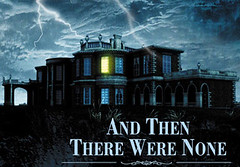
And Then There Were None


And Then There Were None
Originally uploaded by barbfecteau.
Now this is what I call summer reading! This was a fun read with no excess learning. Just a really good, somewhat gory story. The ending was wonderful. I read it late at night and I kept trying to stay awake to find out who the killer was and yet I was exhausted but I needed to know! Finally I read the last chapter and fell asleep with the mystery solved. When I woke up the next morning I couldn't for the life of me remember who it was! So I got to read the whole last chapter again and it was brilliantly revealed, again!

Agatha Christie was never on my list of mystery writers for some reason, but I plan to read her now. Although I hear that once you start reading a lot, it becomes pretty easy to determine "who done it".

I will say nothing about the story because it is pretty much all crime and denouement. But basically people are getting killed left and right and the survivors are getting pretty nervous. I have already put the movie in my netflicks queue.

And since I recommend all my favorite mystery authors in the Early Autumn posting I will refrain from listing them again. But I will add Walter Mosely, who I mentioned in the Uncle Tom's Cabin post as a writer on slavery and the black experience, because his Easy Rawlins mysteries are unbeliveably good. And if you like the English mysteries Martha Grimes has a wonderful series, each of which is named for an English pub. There is a Scottish series set in a small town by M.C. Beaton which are clever and easily digestible.

Thursday, August 24, 2006

The Once and Future King


The Once and Future King
Originally uploaded by barbfecteau.
Well, this was a long haul! I liked this book very much once I got into it. The first 5 chapters were a bit painful until I got used to the tone of the story. And the vocabulary! I have an excellent reading vocabulary (although my speaking vocabulary could use some work) and yet there were more than 15 words I didn't even recognize in those chapters! True, most of them were falconry terms - but still, it made me feel stoopit. And I was on an airplane with no dictionary to look up these words - making me feel trapped as well. It was not pretty. But as soon as Merlin came on the scene, I fell in love with him and the book sailed by.

Until Wart pulled the sword from the stone. (I hope I am not giving anything away there.) At that point I realized - this is a heckuva long book and I still have to read a ton more. And so I took a poll. I asked every future senior I came in contact with through church or the Y or randomly running into them at the beach - "What did you think of The Once and Future King?" And after much piercing Veronica Mars-like questioning they all admitted that they liked it fine but they didn't finish it. "AHA!" I yelled (quietly to myself) "This means that I don't have to finish it either!" So I didn't. But I read enough and I promise that before next summer I will finish it. Probably. Geeze, it's long.

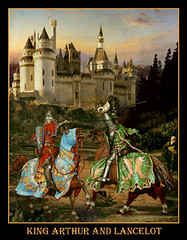
There is something about King Arthur and LONG that must be set in stone. (Like the sword - ha!) Because every Arthurian saga is as long as a Indiana freight train. Seriously - Camelot, the musical, is nearly 3 hours long. The Mists of Avalon (A feminist version of the Camelot legend - it is great!) is a whopping 912 pages. Monty Python and the Holy Grail was short but left out, well pretty much everything but the llamas. And even Disney's The Sword in the Stone only used the first section of the book, with a bunch of other made up things. So there.

Wednesday, August 23, 2006

Alice in Wonderland


Alice in Wonderland
Originally uploaded by barbfecteau.
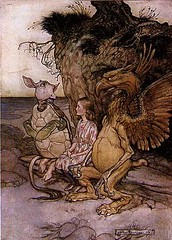
What a shocking surprise! I hated Alice in Wonderland. It irritated me and I don't like Lewis Carroll. I think he is twee. I didn't like the Disney cartoon of this book and I figured that it was just some sort of anomaly and I would surely like this fanciful Victorian story. I love the fanciful. I love the Victorian. But not this. Phooey.

If you like Lewis Carroll - bully for you. Read more of him. I have finally understood what I call "The Elvis Conundrum". My husband hates Elvis Presley. Can't stand his music, his shiny suits or his wacky blue-haired fans. The question is: how can you claim to love rock and roll even a little bit, without respecting Elvis for making it into a phenomenon and therefore appreciate his music on some sort of historical level? My spouse says Elvis-appreciation is not a prerequisite for loving rock and roll. And now I find that, while Lewis Carroll lovers argue that: "The humor, sparkling wit and genius of this Victorian Englishman have lasted for more than a century. His books are among the most quoted works in the English language, and his influence (with that of his illustrator, Sir John Tenniel) can be seen everywhere, from the world of advertising to that of atomic physics." I am still completely unmoved by him. And don't like him. Not even one little bit! I am sure it is some sort of flaw in me and not in the millions who have adored this timeless classic. But that's my story and I'm sticking to it.

If you want children going to strange worlds where things are not at all what they should be (and that I like) - read E. Nesbit or Edward Eager.

Tuesday, August 22, 2006

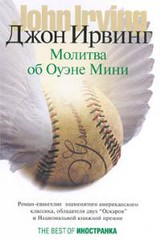
A Prayer For Owen Meany


A Prayer For Owen Meany
Originally uploaded by barbfecteau.
This book was odd. I found it interesting, but the characters weren't conventionally likeable and it was deeply strange. Also deeply moving. I would call reading it a positive experience, but it wasn't a favorite.

Here are some other opinions if mine is too namby-pamby.

That being said, the last hundred pages or so - when everything looks like it is spinning out of control and you wonder how Irving is going to make sense of the whole thing - are brilliant!

I absolutely loved two other books by Irving - The World According to Garp and A Widow For One Year. I have read a couple others which did nothing for me. And I hear Cider House Rules is wonderful as well and someday I will give it a go I am sure.

And this book allows for some lovely recommendations of books that it seems like I am the only person who has ever read. For books about wee people, try Maybe the Moon by Armisted Maupin and Little Little by M. E. Kerr. A wonderful book about the Vietnam era and student life/draft resistance The First Few Friends by Marilyn Singer is interesting. And the book that started it all for garden variety small town weirdness - Peyton Place by Grace Metalious. Okay - lots of people have read Peyton Place, but not lately!

And so there it is - I am as smart as a future junior. Only the senior books to go and I still have a week and a half before school starts! (If the truth be known, I am still writing about the books I read when I was away. I am nearly halfway through the senior books - right now - but I have to write about them in the order I read them or, um, the universe will explode or something really bad will happen or I'll have to wash my hands over and over... What can I say? I like order.)

Please disregard that last paragraph.

Monday, August 21, 2006

Ordinary People


Ordinary People
Originally uploaded by barbfecteau.
Can it be that the movie Ordinary People was actually better than the book? Is the world tilting off its axis? Are those the four horsemen of the apocalypse watering their horses at my sump pump drain? I believe it is so! I remember seeing and loving this movie when I saw it as an angst-y teenager. Of course it was back when a fairly ordinary movie could surprise me. But I digress...

I imagine that sometimes this book gets read because it looks short. But it reminded me of Ethan Frome in that, while it was interesting, I don't think that it would be that appealing for a summer read that is supposed to inspire a love of reading. It was interesting in that it is always interesting to see how other people live - spying, in a sense. But it didn't grip me emotionally the way the movie did. I think that can be attributed to the performances of the actors giving more information about the characters by the way they portrayed them than is actually given in the book.

I do like domestic fiction as a rule and how the death of one character affects those left behind. My absolute favorite book that deals with that is The Magician's Assistant by Ann Patchett, a writer I have been dying to recommend ever since I started recommending books here. Also, I suppose in a way, The Giant's House by Elizabeth McCracken. A couple of writers who manage to take sort of ordinary people and make their stories fascinating are Anne Tyler and Alison Lurie. And if you didn't like Ordinary People, rest assured that these other writers will not disappoint.

Sunday, August 20, 2006

Cat's Cradle


Cats Cradle
Originally uploaded by barbfecteau.
Well this was a fun one! I was looking forward to Cat's Cradle and it didn't disappoint. I had read a little bit of Vonnegut before - just Slaughterhouse Five and Mother Night. But there is always the possibility that a book by an author you had heretofore liked will turn out to be lousy. But this was not the case.

I don't want to say much about the plot because the plot kind of sneaks up on you in this book. It was what I liked most about it. I also loved the format of having a ton of very short chapters that have evocative titles. And I hated the idea of Mona until chapter 93 when I found out that she was not at all what she seemed. But mostly, this is a book of men, men, men, men.

Vonnegut is in the category of writers that I call "The-writers-who-were-enjoyed-by-the-pretentious-boyfriends-of-my-youth". These writers are actually fascinating and I try to keep the origins of my interest in them in a separate locked portion of my brain and enjoy them on their own merits. They include, but are not limited to: Thomas Pynchon, T.C. Boyle, Hunter S. Thompson, Lester Bangs, Tom Robbins, Jack Kerouac and Graham Greene. Okay, I am just kidding about Graham Greene - but he is a really good writer, too. All of these writers are fascinating and different from each other and different from anyone else you may have read. If you like Vonnegut and you are looking for something unusual - give one of those guys a try.

Thursday, August 17, 2006

The Orchard


The Orchard
Originally uploaded by barbfecteau.
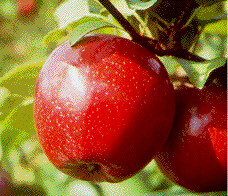
The Orchard was a little unnerving at first. It looked like something that would interest me. A young woman during the Depression manages to keep her family’s farm by running it herself. I was assured by my sources that no one ever reads this for summer reading and I can see why. It is both long and about fruit. If I were in high school I would avoid it like a bag full of maggots. However, being quite dull myself and a fan of fruit – I found that I enjoyed it very much.

The story behind the way it was published was interesting to me. The daughter of the writer found the manuscript and had it published posthumously. (The daughter wasn’t dead yet when she had it published, of course, but the mother/writer was. Just want to be clear.)

The very beginning of the book had me worried. The daughter wrote the very earnest introduction and I read it. I know, I know – I keep telling people “For the love of all things holy – do not read introductions until after you have read the book!” And then I don’t take my own advice. So the tone of the introduction was a wee bit irritating to me. It seemed that the writer implied that, like an apple a day, this book was going to be good for me. I don’t want to be improved by a book, I just want to enjoy it. And so I pursed my lips and got ready to take my medicine. Luckily the book itself was not distasteful at all, but really interesting and surprisingly funny in parts.

There are very few characters in the book, mostly just Kitty, her dog, and the men who worked for and with her. When people start talking about the rhythm of a book, I begin to get nervous. But this book really had a good rhythm. It made me conscious of the seasons in a way that books never do. (Names, clothes and seasons in books never make an impression on me. Everything I read could be about naked people named John and Nancy and take place in a weather-free environment and I would barely notice.) And I learned more than I ever thought I would about growing apples.

I don’t read a lot of books about farming. But I read a ton of books about the Depression. I probably already mentioned some of them. One that reminded me a lot of The Orchard - in that it was about a person who has far better survival skills and useful knowledge that I have – is Hitch by Jeanette Ingold. It is the story of a boy who joins the civilian conservation corps in the 30s. It is a sequel and I look forward to reading more about this character. Also, I would be a bad librarian if I didn’t recommend The Grapes of Wrath. I loved it and it is an interesting look at what was happening on the other side of the country at the time The Orchard took place.

Speaking of weather – the next book up, Cat’s Cradle, is one in which I did notice the weather. And it is awesome! (Hope I am not giving anything away…)

Tuesday, August 15, 2006

Ironman


Ironman
Originally uploaded by barbfecteau.
I like Chris Crutcher a lot. And apparently, so do many of you. According to a few English teachers who teach Ironman in their classes, it is a favorite. And with good reason. Everyone(except mean people) likes the story of an underdog who emerges victorious over all the people who try to keep them down.

I read this weeks ago and thus have forgotten most of the important plot points. So I will just say that I remember his father is a controlling horror show and his teachers (except for his evil coach) are pretty nice. I thought the other kids in the anger management group were really well written, too. And there is a big race at the end. I wonder how that will turn out...

I just read my first Chris Crutcher book last summer The Sledding Hill and it was fantastic - it is told from the point of view of a dead boy. I also liked Staying Fat for Sarah Byrnes, for the title alone. Ironman reminded me of Alt Ed by Catherine Atkins, another story of high schoolers who are brought together to work out problems that are generally the result of other people's messed up behavior and attitudes. Another great book about friendships that save lives is Fat Kid Rules the World by K.L. Going.

Monday, August 14, 2006

Early Autumn


Early Autumn
Originally uploaded by barbfecteau.
I absolutely love the Spenser mysteries and Early Autumn is one of my favorites. Three or four years ago I spent part of the summer reading all of the Spenser novels in chronological order. It was wonderful. As I was re-reading this I had all these wonderful ideas about what I was going to post here. They were very insightful and it very likely would have changed your life to read them. Sadly, this was way back the last week of July and I now can remember none of these ideas. So I will just give you my two negative thoughts about the Spenser books:
1. I hate the way Spenser admires Susan's bird-like appetite. Please, she probably binge-eats the minute she gets out of his sight.
2. I think Susan is kind of a whiner early in the series. She gets better.

I love everything else about them. There is a fantastic website by a man with a lot of time on his hands that cites all the allusions in the books. And I am a big enough Spenser geek that I have submitted a few. My favorites in the series are Potshot and Ceremony.

Some librarians (and English teachers and publishers and other reading-types) look down on genre fiction, by which they mean mystery, romance, science fiction and other topics that can be easily categorized. This strikes me as quite unfair because often people get so sucked down a rabbit hole of trying to define types that they just forget to just enjoy reading. Within the mystery genre there are many enjoyable books (and series). Here are a few of my favorites.

The Beekeepers Apprentice by Laurie R. King. The protagonist is Mary Russell an impoverished young girl genius who befriends an aging Sherlock Holmes.

The Thomas and Charlotte Pitt series by Anne Perry. Beginning with The Cater Street Hangman and continuing for 24 more books, these are a detail-rich Victorian mystery series.

Maisie Dobbs
by Jacqueline Winspear. A former ladies maid turned detective solves mysteries that generally have to deal with World War One.

Lest you think that I only read about English girl detectives:

The Kinsey Milhone Mysteries
by Sue Grafton. Starting with A is for Alibi and going all the way to S is for Silence - these books follow the adventures of a P.I. with a horribly pathetic social life and a real gift for getting to the bottom of things.

I also like Agatha Christie, Janet Evanovich, Martha Grimes, Nancy Drew, The Happy Hollisters and Beverly's own Dana Cameron. And if you absolutely must watch television - my new favorite detective is Veronica Mars. But don't tell anyone I am recommending television - even though the show's creator is Rob Thomas - author of Rats Saw God - a great young adult novel. Feel free to come get it at the library!

Tuesday, August 08, 2006

The Education of Little Tree


The Education of Little Tree
Originally uploaded by barbfecteau.
Good grief it has been a long time! I am back from the wilds of the Midwest where I read every single book from which the juniors-to-be can choose. I think I might even be able to pass the MCAS at this point, I am feeling so smart.

I didn't expect to like The Education of Little Tree too much. I don't like nature books and any jacket copy that says a book will change my life makes me get huffy and think, "What on earth makes you think I would like my life changed?" However, it was lovely. Funny, sad, full of life lessons - it was a life-changer, if you are the sort of person who goes in for that kind of thing.

The story is about a young boy who loses his parents and goes to live with his Cherokee grandparents during the Depression. There are stories of dogs and Indian history and how to make whisky and orphanages. It is well worth reading.

I don't recall having read many books about nature or living in harmony or grandparents or making whisky. There are a million and twelve books about losing parents. Which leaves me with books about Native Americans. My favorite book by an Indian writer is The Lone Ranger and Tonto Fistfight in Heaven by Sherman Alexie which is a series of short stories part of which was made into a great movie called Smoke Signals. I also loved The Bean Trees and it's sequel Pigs in Heaven which tell the story of a young woman who finds an Indian baby and the family that they become.

Now don't read any further until you have finished the book.

I'm waiting.

No hurry.

Okay here is the thing; there is some controversy about The Education of Little Tree. If you want to click the link there is a well documented article the gist of which is that this book is in no way autobiographical. Forrest Carter was a segregationist and a leader in the Ku Klux Klan who wrote extensively about the superiority of the white race. Does this make Little Tree a bad book? I don't know. I really liked it and I am glad that I read it before I knew this. I think that it would have diminished my enjoyment a great deal if I had known. (See my soon-to-be-written posting on Alice in Wonderland for more discussion on this topic.)

Thursday, July 20, 2006

The Glass Menagerie


The Glass Menagerie
Originally uploaded by barbfecteau.
Please be aware that I read this two days ago and it was only my inability to find an appropriate picture that kept me from posting two days in a row! I finally went with the creepy album cover rather than the neon unicorn - but it was a hard decision.

Here's a tip. If you are writing an essay about The Glass Menagerie and don't mention the broken unicorn you're not paying attention. Not only did I love Laura's response to that, but it was also such a blatant use of symbolism that even a dense-headed reader like myself spotted it.

This was a beautifully written play. I wanted to pick little bits of the language out to post here, but they don't really work outside the structure of the play. I read this in one short afternoon at the YMCA. And yes, I do a lot of good reading there. What else am I going to do? Exercise? Anyway Alex Hurst of the BHS class of 2005 was lifeguarding and came over to me and said in a voice filled with the joy of reminiscence, "Oh! The Glass Menagerie! I read that for summer reading!" I was so pleased that he remembered the book - I asked if he liked it. "Of course," he replied, "look how short it is!" And with this I began quietly weeping.

Anyway - aside from its charming shortness this play also has depth and a lot of moral ambiguity. Is Tom a hero for saving himself or merely another selfish troll in a line of selfish trolls deserting the weak? I make it sound like I have an opinion, but I am actually very conflicted which is one of the reasons I really loved reading this.

Just a side note - with The Glass Menagerie, I have finished all of the summer reading books that I have previously read (which are really just this and Fahrenheit 451) so from here on out - they are all mysterious to me!

I didn't have a lot of books that came to mind after I read this so I asked some friends for suggestions for books with strong mothers who boss their children to near the point of insanity. They came up with Pride & Prejudice and A Light in the Piazza. Here is a shocking revelaton - I have never read P&P! I have seen several versions of the movie and it was my senior play in high school where I (if I do say so myself) stole the show with my magnificent swooning as Mrs. Bennett. I whipped through A Light in the Piazza and found it somewhat depressing and yet interesting. Basically a mother arranges a marriage for her strange little daughter in Italy in the 1950's - or as the book jacket calls it "modern times". Ha!

Really, if you like The Glass Menagerie you should just read more Williams. A Streetcar Named Desire is amazing. Also - the Beverly Public Library has Selected Letters of Tennessee Williams which is fascinating.

Tuesday, July 18, 2006

Uncle Tom's Cabin


Uncle Tom's Cabin
Originally uploaded by barbfecteau.
It took all week but I finally finished! I was dreading this book. It was written in 1852 and much of it is in southern dialect and it just seemed hard. But much to my surprise I really liked it.

It needs to be said that from our perspective as twenty-first century Americans this book is racist and very patronizing. But it is also a very compelling story and moving as well. And the motives of Harriet Beecher Stowe were pure in her raging desire to bring slavery to an end. It is easy to believe the legend that when Abraham Lincoln met the author her said, "So you're the little lady who made this big war."

I don't know that I would have made it past chapter one if it hadn't been for my friend Nicole. Before I started the book I asked her, "How much of this do I really have to read of this before I switch to the SparkNotes to be able to claim that I read it?" She looked at me with such disappointment in her face and said, "You must read it all." And so, to keep my sterling reputation as an actual reader of books I did. And I don't regret it a bit. Nicole is so proud of me! And she also recommended two narratives written by slaves which are available on-line Narrative of the Life of Henry Bibb and Incidents in the Life of a Slave Girl by Harriet Jacobs. Both are fascinating and moving.

I would also recommend two books that deal with slavery and its aftermath that I found to be excellent. Beloved by Toni Morrison absolutely haunted me. So much so that I never even watched the movie. Toni Morrison is an unbearably good writer. Another of my favorite authors is Walter Mosely. (He was also former president Bill Clinton's favorite writer, so make of that what you will...) I am a huge fan of his Easy Rawlins mysteries which I will recommend again when I am writing about Early Autumn. He has written an interesting young adult novel about a slave who is made immortal called 47.

One note about this novel - you need to remember the historical context. The author makes sweeping racial generalizations about slaves - generally positive but still very stereotypical. There was also a casual bit of anti-semitism. And finally - so much evangelical preaching that I felt as if I were still in the halls of the baptist high school I attended. The dialect and the exhortations to the reader make the writing seem a bit awkward. But it is a novel that helped our country evolve towards a more equitable and humane future.

Monday, July 17, 2006

I have returned from the beautiful northwest. And I read all but one of my selections. Here are the updetes on what I read. And I apologize because I am sure that you were being kept up nights wondering what on earth I thought of these books!

The Queen's Foolby Philippa Gregory was wonderful - very compelling. The heroine was one of those types that you sometimes want to shake by the shoulders and tell her to pay attention. Other than that it was a fast paced, fascinating read.

Rebel Angels by Libba Bray was wonderful. I had a student snach this from my hands the minute it came into the high school library and now I know why. It was exciting with a much more detailed look at the mystical aspects of the story.

Beauty by Sherri S. Tepper and I didn't get along. There is an excellent Reader's Pledge that I would like to invoke. If you find a book boring you don't have to finish it according to writer Shannon Hale who I have never read but intend to very soon.

Love Walked Inby Marisa de los Santos was lovely! It surprised me a lot. The main character is a little too perfect and everyone is pretty, but the emotions felt real and the story was heartbreaking and hilarious at the same time.

Harry Potter and the Half Blood Prince by J.K. Rowling - I am convinced that Snape was just doing what Dumbledore wanted him to do. And I am being vague here in case you haven't read it. The book would just be too sad if it were otherwise. I am waiting anxiously for the next and final installment. As for this "Who is going to die?" brouhaha - my money is on Snape and Neville.

I am very nearly done with Uncle Tom's Cabin, my first selection from the Junior class list. It is taking a long, long time - but I am going to rip through The Glass Menagerie like a sneeze through a kleenex just as soon as I finish. So brace yourself!